Luxor Temple Egypt Guide: Spiritual Legacy and Architectural Wonder on the East Bank
On the East Bank of the Nile, Luxor Temple Egypt stands as a monument to kingship, faith and the passage of civilisations — a site of profound beauty that rewards every culturally curious traveller. From the Avenue of Sphinxes to the magical atmosphere of Luxor Temple at night, this is ancient Egypt at its most awe-inspiring.
A Monument That Transcends Time
On the East Bank of the Nile, where the ancient city of Thebes once commanded the known world, Luxor Temple Egypt stands as one of the most compelling historical sites on earth. Built predominantly in the 14th century BCE, this extraordinary complex was not dedicated to a single deity but to the renewal of kingship itself — a concept as grand and enduring as the sandstone columns that still reach skyward today. For culturally curious couples seeking a destination that stirs both the intellect and the imagination, few places on earth come close.
Pharaohs Who Shaped the Stone
The temple owes its essential character to two towering figures of antiquity: Amenhotep III, who commissioned the elegant colonnade and inner sanctuary, and Ramses II, whose additions — including the monumental entrance pylon — gave the complex its imposing scale. Yet the story did not end with those two great rulers. Tutankhamun contributed reliefs celebrating the Opet Festival, while Alexander the Great, ever keen to legitimise his rule through association with Egyptian tradition, added his own sanctuary within the precinct. Each addition layered new meaning onto the stone, making Luxor Temple a palimpsest of ambition and devotion.
The Avenue of Sphinxes and the Opet Festival
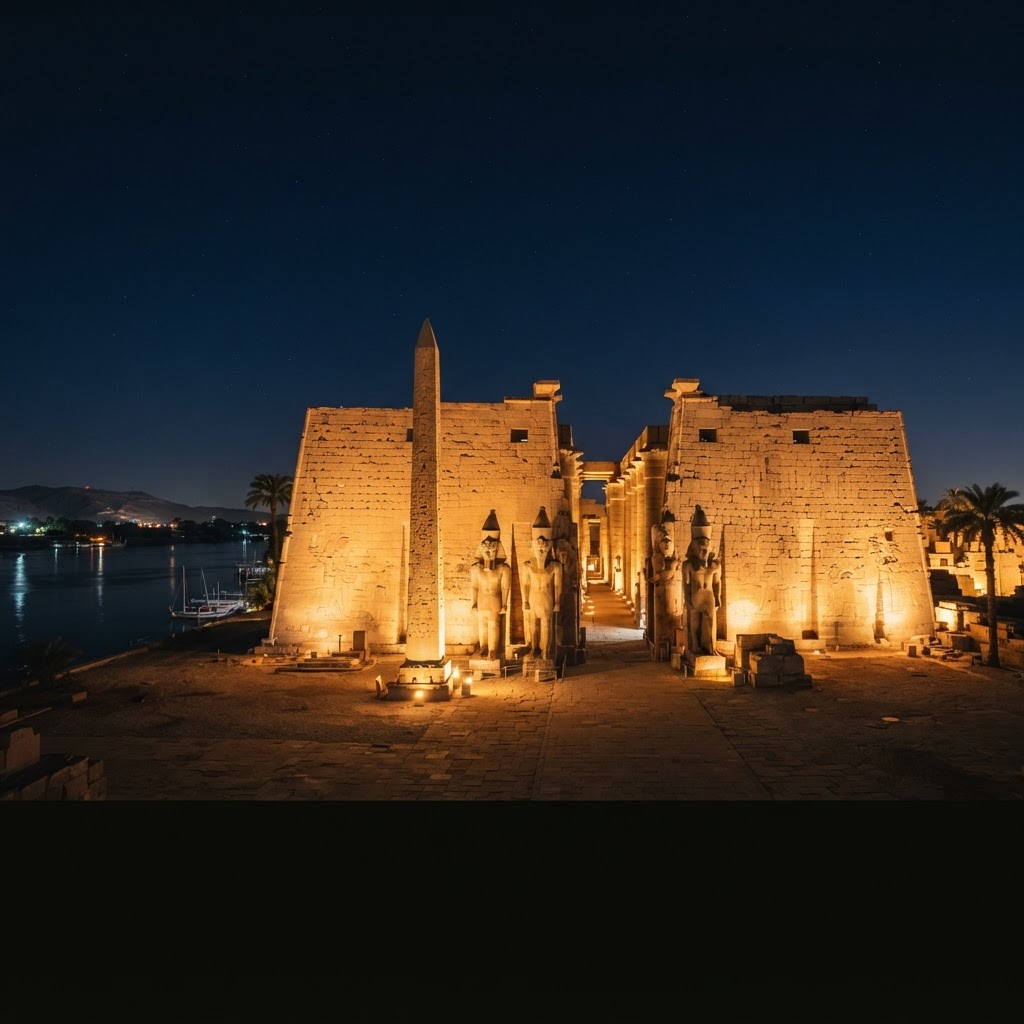
Stretching northward from the temple entrance, the Avenue of Sphinxes once formed a ceremonial processional route linking Luxor Temple to the vast complex at Karnak Temple, roughly three kilometres away. This sacred road was the beating heart of the Opet Festival — an annual celebration of fertility, renewal and the divine legitimacy of the pharaoh. Guarding the main pylon, colossal seated statues of Ramses II gaze serenely across the forecourt, while the base of a single remaining obelisk recalls a pair that once flanked the entrance. Its twin was removed in the 19th century and now stands at the Place de la Concorde in Paris, a reminder of how far Luxor's legacy has travelled.
Layers of Faith Within a Single Structure
Perhaps what makes this Egypt historical site truly singular is the way successive civilisations chose not to erase what came before, but to build upon it. The Romans converted a section into a military chapel. Early Christians raised a church within the ancient walls. And a mosque — the Mosque of Abu Haggag — still functions today, perched atop accumulated centuries of history, its minaret rising above the pharaonic stonework. Inside the temple, hieroglyph-covered courtyards and colonnaded halls record the divine relationship between rulers and gods, presenting the pharaoh as the essential bridge between the mortal and the celestial.
Luxor Temple at Night
If you visit the temple during daylight hours, do not leave Luxor without returning after dark. Luxor Temple at night is an experience of an entirely different order. Floodlights throw long shadows across the columns and statues, lending the complex a drama that feels almost theatrical. The scale of ancient Egyptian artistry becomes newly apparent, and the atmosphere — warm air, the distant sounds of the city, the golden glow on ancient stone — can feel genuinely timeless. Standing in the forecourt as evening settles over the East Bank of the Nile, it is easy to believe that something of the ancient kings still lingers here.
Plan Your Journey with Citibond Holidays
Luxor Temple Egypt is far more than a collection of ruins — it is a living monument to human devotion, political genius and spiritual endurance, its story still accumulating with every passing year. Whether you are drawn by the grandeur of Ramses II, the mystery of the Opet Festival or simply the romance of standing beside the Nile at dusk, Luxor rewards every kind of curiosity. To explore how you can experience this remarkable destination for yourself, get in touch with Citibond Holidays and let our team help you plan an unforgettable journey to one of the world's greatest historical sites.